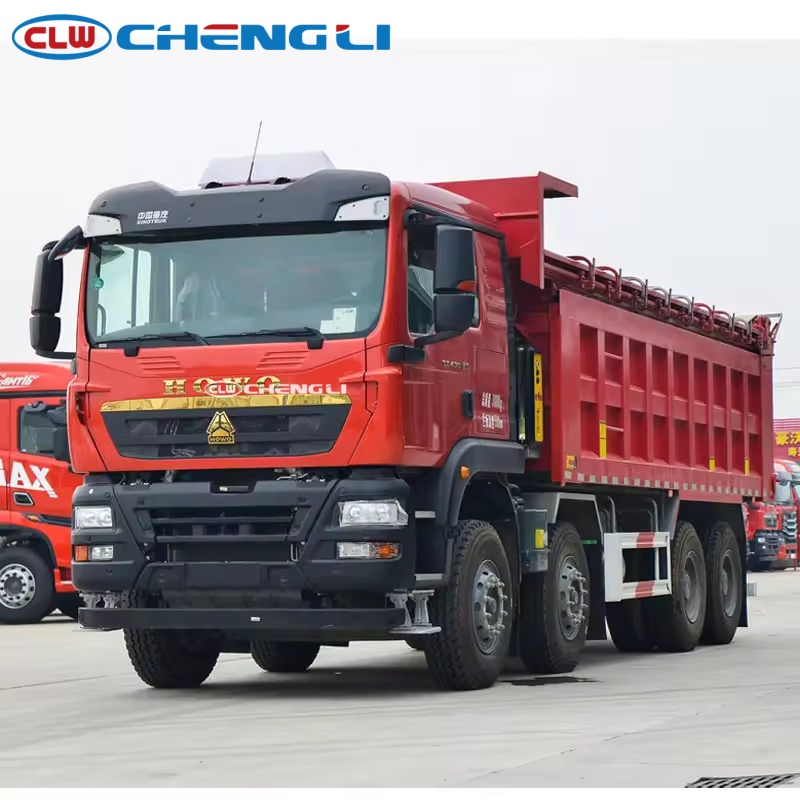
Choose between a 6×4 and an 8×4 tipper by checking the load, axle distribution, route and unloading conditions of the complete truck. An extra axle is not an automatic guarantee of more usable payload, better traction or a lower operating cost. The most suitable vehicle is the one whose approved specification fits the work and whose dimensions fit the route.
Both layouts appear in our dump truck and tipper range. Chengli Group can configure the body and working equipment around the chosen chassis. Use the comparison below to narrow the enquiry, then compare actual models rather than making a purchase decision from the drive notation alone.
1. Understand what the notation tells you
In the usual rigid-truck description, 6×4 identifies a three-axle layout with two driven axles. An 8×4 identifies a four-axle layout with two driven axles. These descriptions do not specify the wheelbase, cab, tyre sizes, axle ratings, suspension or permitted completed mass. They also do not tell you the manufacturer's load distribution for a particular body.
The distinction matters because an 8×4 is not four-wheel all-wheel drive simply because it has more axles. Both configurations need a suitable traction and tyre specification for the intended surface. If the route requires driven front axles, that is a different chassis question and should be stated explicitly.
As a manufacturer reference, Volvo's construction range describes multiple axle configurations and separate all-wheel-drive options. That example illustrates why axle arrangement belongs in a complete specification; it does not establish the performance of a Chengli vehicle or promise that a particular chassis is available for your order.
2. Compare the complete vehicle, not an assumed ranking
| Selection question | Check on a 6×4 proposal | Check on an 8×4 proposal |
|---|---|---|
| Required cargo mass | Actual payload and loaded axle distribution | Actual payload and loaded axle distribution |
| Body volume | Material density against usable volume | Material density against usable volume |
| Route access | Overall length, wheelbase and turning space | Overall length, wheelbase and turning space |
| Surface and gradients | Driven axle arrangement, gearing, tyres and braking | Driven axle arrangement, gearing, tyres and braking |
| Unloading | Stable working position and body lift clearance | Stable working position and body lift clearance |
| Commercial comparison | Same equipment and delivery scope | Same equipment and delivery scope |
This is deliberately not a table declaring one layout better. A lighter or differently equipped four-axle vehicle can differ substantially from another four-axle vehicle. A three-axle truck with a smaller body may fit a restricted delivery area that a longer configuration cannot negotiate. Check dimensions and the operator's route requirements before deciding.
The HOWO 6×4 10-wheel dump truck and the Sinotruk HOWO TX 8×4 dump truck provide two configuration pages for that comparison. The shared HOWO name does not make their bodies, engines or permitted loads equivalent.
3. Keep body volume, payload and vehicle mass separate
Body volume is the space available for material. Payload is cargo mass. Gross vehicle weight describes the complete loaded vehicle, while curb or unladen weight describes the truck without its cargo under the applicable specification. Do not substitute one of these terms for another on a comparison sheet.
For a known material density, multiplying usable body volume by density gives a planning estimate of cargo mass. That estimate still needs to be checked against the vehicle and axle limits. Wet material, mixed loads and uneven filling can change the practical result. Ask your site team for representative density and loading information instead of adopting a generic conversion factor.
An enlarged body can add weight as well as space. Thicker plate, liners, covers and hydraulic equipment also contribute to the completed truck's mass. Request a mass and axle-distribution review for the actual build, not only the chassis manufacturer's bare chassis rating.
The Sinotruk HOWO 8×4 39,500 kg GVW configuration illustrates why the product's individual mass and body fields should be read together. A number in its name is not a universal limit for every HOWO 8×4 truck.
4. Review the route and tipping position together
Document the loaded route, return route, gradients, tight turns, bridge or gate constraints and the ground at the unloading point. Ask for the relevant dimensions and chassis data for each proposed model. Ground clearance, tyres, suspension and powertrain need separate review; axle count is not a shortcut for rough-road suitability.
Tipping adds a different stability problem from driving. HSE's tipping guidance calls attention to stable ground, side slopes, overhead hazards and uneven loads. Include those conditions in the procurement brief and follow the operating instructions for the selected truck. More axles do not remove the need for a safe unloading area.
If material is likely to stick, describe it when specifying the body, liner and tailgate. Provide loading equipment dimensions and the expected discharge method. The supplier needs this information to propose a compatible body and lifting system, rather than simply offering a larger truck.
5. Build two genuinely comparable enquiries
Prepare one working brief and ask for a suitable 6×4 proposal and a suitable 8×4 proposal against that same brief. Include the material, cargo mass, haul distance, loading equipment, unloading position, steering side, destination and quantity.
Ask each quotation to show chassis model, engine, body dimensions and material, hydraulic equipment, completed mass, axle distribution and delivery scope. Compare the required work cycle first, then purchase and support costs. If one offer changes the body or operating assumption, record that difference before treating its price as comparable.
Project customisation and OEM/ODM are available from Chengli. Body dimensions, steel, liners, covers and working equipment can be discussed alongside the chassis. Final technical specifications and commercial terms are agreed in the quotation.
Send the route and load brief if you need help choosing between the configurations.