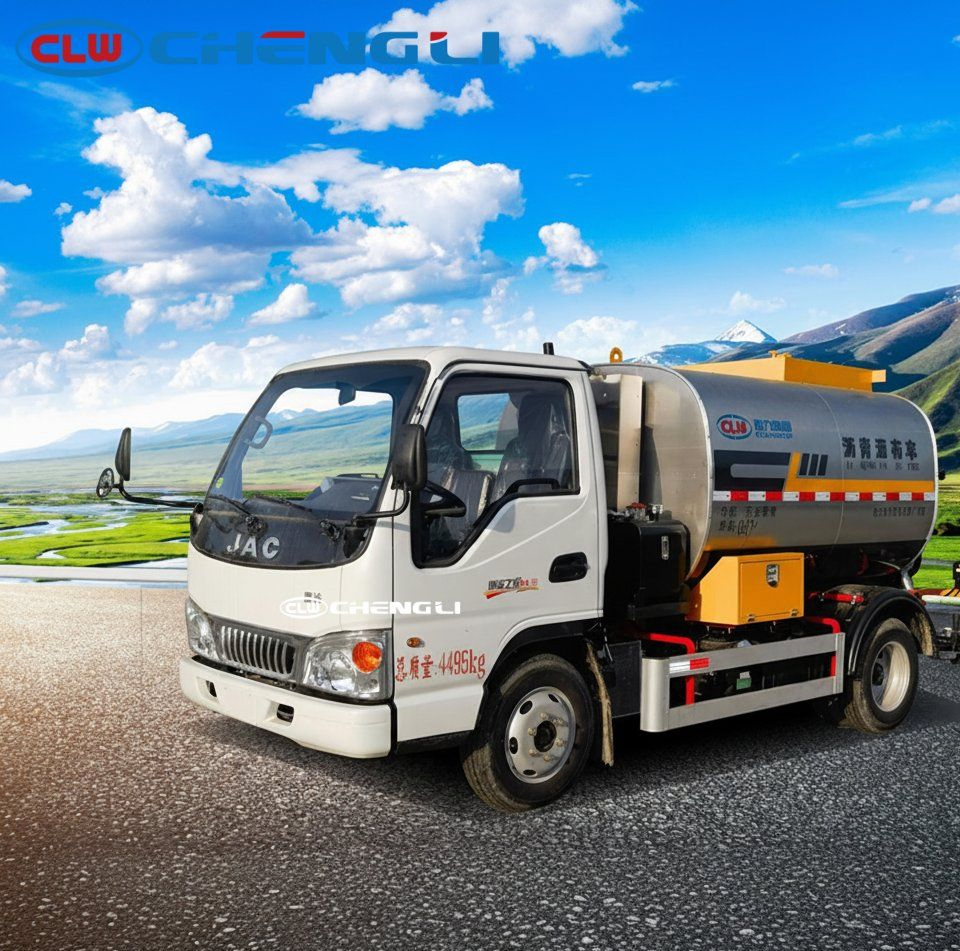
Choose a bitumen sprayer or asphalt distributor by the binder, required application rate, working width and refill pattern, then compare the tank, heating, pump and control package. Tank volume alone does not establish daily output or suitability for a particular binder. A smaller unit can fit a restricted maintenance job, while a larger configuration may reduce replenishment stops on a continuous road section.
The asphalt distributor truck range includes the configurations below. Bitumen sprayer and asphalt distributor are useful search terms for the same purchasing discussion, but the exact equipment still needs to be specified. This guide compares vehicle features, not a paving design or a guaranteed treatment rate.
1. Match tank size to the working section
Begin with the area to be treated between refills, the binder to be used and the project application rate. Include the distance to replenishment and the space available for the truck. Separate nominal tank volume from operating fill and the complete loaded vehicle mass.
| Configuration | Tank capacity | Spray width | Heating |
|---|---|---|---|
| JAC CL5043GLQ6BLS | 4,500 L | 3.6 m | Thermal-oil circulation |
| Dongfeng CL5040TJS6ALS | 5,500 L | 3.6 m | Thermal-oil circulation |
| Foton CL5042TJS6ALS | 5,500 L | 3.6 m | Thermal-oil circulation |
| Dongfeng CL5121GLQ6LS | 5,000–6,300 L | 4.5 m; optional 6 m bar | Thermal-oil circulation |
| Dongfeng CL5110GLQ6BLS | 6,300 L | 4.5 m; optional 6 m bar | Thermal-oil circulation |
| Dongfeng D9 4×2 distributor | 10,000–12,000 L | 4.5 m; optional 6 m bar | Thermal-oil circulation |
| Dongfeng CL5161GLQ6LS | 10,000–12,000 L | 4.5 m; wider bar optional | Thermal-oil circulation |
| HOWO 4×2 asphalt distributor | 4.5 m; optional 6 m bar | ||
| FAW Jiefang CL5160GLQ6LS | 4.5 m; optional 6 m bar | Thermal-oil circulation |
Only specified comparison values are displayed; an empty cell does not mean the equipment is absent. Capacity ranges remain ranges, and optional wider bars are not presented as standard equipment. These are different configurations, not a ranking based on the number in a model code.
The JAC and Foton entries offer 3.6 m spray widths. Several intermediate configurations give 4.5 m bars with a 6 m option. The 10,000–12,000 L Dongfeng configuration combines a larger nominal tank range with a 4.5 m bar and a wider-bar option. Compare the proposed build and its working position rather than assuming the widest bar comes with every tank.
2. Specify spray width and application control together
Working width should match the treatment section, overlaps and restricted areas. Ask how sections of the bar are controlled and how folding or extending equipment is positioned. Compare transport width and clearance as well as the spray pattern used during operation.
Application rate describes the quantity applied per unit area; pump flow describes liquid delivery per unit time. They are related through working width, vehicle speed and the selected system, but they are not interchangeable specifications. A high pump-flow number is not proof of an even application.
For a hypothetical planning example only, 1,000 m² at 0.5 L/m² requires 500 L before any operational allowance. That arithmetic is not a recommended application rate, an installed calibration setting or a guaranteed usable tank volume. The binder and project specification determine the actual target.
Compare the controls with the operator's required work method. The JAC CL5043GLQ6BLS uses PLC control and an 18,000 L/h pump specification. The Dongfeng CL5121GLQ6LS has PLC control and a 680 L/min pump specification. Keep the units visible and assess the complete system; do not compare the raw numbers without their units.
3. Review binder compatibility and heating
Thermal-oil circulation heating appears across the compared configurations. Sharing that description does not make their burners, heating capacity, insulation or temperature controls identical. Ask for the heating arrangement of the selected build and its suitability for the binder you will use.
Identify the binder grade and handling requirements in the enquiry. Request the operating information for the pump, valves, lines, tank and cleaning arrangement. Do not assume a vehicle specified for one binder can handle every emulsion or hot product under the same settings.
Heating choice should follow the operating duty, not a general promise of faster work. Consider waiting time, refill practices and access to the system for inspection. Burner selection and any optional equipment should be identified in the offer, rather than inferred from a photograph of a different configuration.
The Dongfeng CL5161GLQ6LS is equipped with pneumatic and diesel cleaning functions. Treat cleaning as a defined system with its own operating instructions, not a universal procedure to apply to every binder. The operator needs the correct shutdown and cleaning method for the ordered equipment.
4. Compare quotations against one roadwork brief
Give the supplier the binder, treatment area, project application rate, desired width, refill location and expected work cycle. Include the route, access restrictions, chassis preference, steering side, quantity and destination. Indicate whether the work is dispersed maintenance or a longer continuous section.
Ask each offer to identify tank volume, completed mass, pump, heating system, controls, spray-bar width and optional sections. Include handheld application equipment only if it is required and specified. Review the proposed vehicle dimensions and the room needed to deploy or fold the bar at the working site.
Chengli provides project customisation and OEM/ODM. A useful comparison keeps chassis cost and working-system cost visible and records each optional item. Reference prices on configuration pages are not FOB or CIF quotations; the final offer sets the agreed equipment, quantity and delivery scope.
Send a roadwork equipment enquiry with the binder and working width first. That allows tank size and the distribution system to be assessed together, instead of choosing the largest tank and discovering later that the spray arrangement does not fit the job.