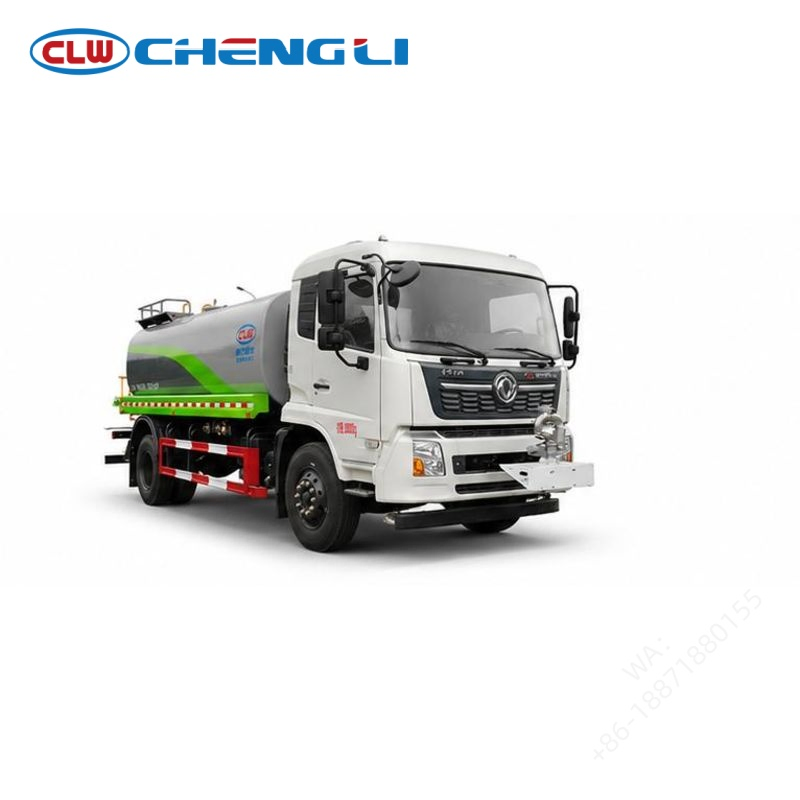
Choose a water bowser by finding out what interrupts dust-control work. A quarry may need longer runs between refills; a large construction site may need a reliable filling network; a haul road may need better spray coverage rather than more tank space. The three projects below show how those problems led to different equipment decisions.
1. Brookby quarry: combine tank size with fast filling and nozzle control
At Brookby Quarries in Auckland, New Zealand, dust control and time lost refilling were linked problems. The site used two custom 17,000 L TTi chassis-mounted units supplied by Condor. Their package included diesel-engine upgrades, cab-operated controls, a quick-fill hydrant connection and individually operated nozzles. Weight-distribution modelling preceded installation. The fitted quarry watering arrangement combined storage, filling and application controls for daily dust-control work. Brookby quarry equipment case.
What to take into a purchase: if a truck repeatedly leaves an active haul road to refill, compare the water carried between stops, the filling connection and the mounted layout together. Ask for a timed refill demonstration at the proposed supply point. A large tank connected through a slow filling line may still spend too much time parked.
2. A California solar build: fix the supply system before adding truck capacity
A solar-and-battery construction site in California's Mohave Desert had pump failures, manual shutoffs and overflowing supply tanks. United Rentals installed nine filling stands, resized the pumps and added automatic tank shutoff. The contractor could then run five water trucks instead of four. United Rentals reports a US$15,000 monthly reduction in water cost. Solar construction water-supply case.
What to take into a purchase: when trucks queue at an unreliable filling point, compare the supply network before deciding that a bigger bowser will solve the problem. Include pump backup, automatic shutoff, storage and the number of simultaneous filling positions. Five trucks operating rather than four means that the water system supported more trucks; it does not mean fewer trucks were needed or prove a particular percentage increase in road coverage.
3. HS2 haul-road trials: more litres do not fix missed road edges
During the 2023 HS2 Sublot 8 trials in the UK, two tractor-and-bowser outfits applied dust-control treatments to 200 m road sections. The equipment lacked accurate liquid measurement and flow-rate control, and a single pass did not wet the running surface evenly. Operators made additional passes along both sides. The additive trial exposed a practical coverage and dosing limitation; the same uneven spray pattern was also relevant to water application. HS2 trial method and application observations.
What to take into a purchase: ask for a demonstration across the intended road width, including the edges, at a stated travel speed. Check how applied volume is measured and how nozzle sections are controlled. Separate a spray-reach claim from even road coverage. The lesson here concerns application equipment; additive mixtures and doses are not plain-water requirements.
4. Turn the site problem into a vehicle comparison
| Problem at the site | First comparison to make | Configuration to examine |
|---|---|---|
| Access is tight around the work area | Overall width, turning space and access to the filling connection | FAW Jiefang 4×2 water sprinkler: 2,350 mm width and 6.88 m³ tank |
| Refill stops interrupt the route | Operating fill, refill time and supply-point capacity | CL5160 4×2 water sprinkler: a 10 m³ tank-volume alternative |
| Different parts of the site need different water outlets | Front, side and rear application duties and the outlets used together | Dongfeng 4×2 water sprinkler: front flushing, side spraying, rear sprinkling and rear water cannon |
The Dongfeng distinguishes 11.16 m³ total tank volume from 10.63 m³ effective volume. Neither establishes an allowed operating fill without the completed-vehicle and axle assessment. The FAW is 200 mm narrower than the 2,550 mm Dongfeng in this comparison; check that difference against the entrance and turning space.
5. Use one refill calculation to compare the alternatives
For an illustrative 1,000 m × 6 m road, eight hourly treatments at 1.75 L/m² require 84 m³ in total: 6,000 × 1.75 ÷ 1,000 × 8. The hourly intensity has a specific project example in the 2014 Anderson Road Quarry assessment, sections 4.7.3–4.7.5; the road dimensions and schedule here are assumptions. They are not the Brookby, solar or HS2 projects, or a universal treatment requirement.
Assume 420 minutes available for the water cycle in a 480-minute shift, filling at 1 m³/min and applying at 0.5 m³/min. A cycle includes the full refill journey, filling and application. Compare two hypothetical working loads:
| Round-trip travel | Working water load | Travel + fill + apply | Complete cycles | Water per truck per shift | Trucks for 84 m³ by shift volume |
|---|---|---|---|---|---|
| 10 min | 6 m³ | 10 + 6 + 12 = 28 min | 15 | 90 m³ | 1 |
| 10 min | 10 m³ | 10 + 10 + 20 = 40 min | 10 | 100 m³ | 1 |
| 50 min | 6 m³ | 50 + 6 + 12 = 68 min | 6 | 36 m³ | 3 |
| 50 min | 10 m³ | 50 + 10 + 20 = 80 min | 5 | 50 m³ | 2 |
With nearby water, both options pass this shift-volume screen. A longer refill journey changes the comparison to three smaller-load trucks or two larger-load trucks. Complete cycles are rounded down and truck counts up, with no credit for an unfinished cycle or allowance for queues. Then schedule the hourly treatments and shared filling positions: an adequate daily total does not ensure water arrives when each road section needs it. These working loads are planning assumptions, not the rated water loads of the three vehicles above.
6. Ask for a demonstration that answers the unresolved question
For a refill problem, time the proposed connection while the truck takes a stated volume. For a coverage problem, observe the road edges as well as the centre and record the speed, outlet selection and volume used. For a supply-reliability problem, review pump duty, backup and simultaneous filling. Keep those observations in the vehicle comparison instead of accepting a tank-size description as the entire proposal.
The example application flow of 0.5 m³/min equals 500 L/min. The selected pump must provide the required flow at the pressure needed by the actual nozzles and pipework; maximum flow and maximum pressure are not one operating point. Flow and head on a pump performance curve help define that review. A long-reach monitor and a road spray bar have different jobs.
Finish the brief with the water quality, filling method, access envelope, outlets used together, destination and quantity. Identify drinking-water transport separately so the tank and pump can be specified for it. Discuss the water bowser and refill arrangement with the operating problem and the comparison results.
Water Bowsers to Compare
- FAW Jiefang 4×2 6.88 m³ Water Sprinkler Truck — Compare its 2,350 mm overall width and 6.88 m³ tank where access is an early constraint; check turning space as well.
- CL5160 4×2 Water Sprinkler Truck — Use the 10 m³ tank as another refill-cycle option, then identify the actual pump and permitted working fill.
- Dongfeng 4×2 10.63 m³ Water Sprinkler Truck — Compare front flushing, side spraying, rear sprinkling and the rear water cannon for separate application duties; distinguish 11.16 m³ total from 10.63 m³ effective tank volume.