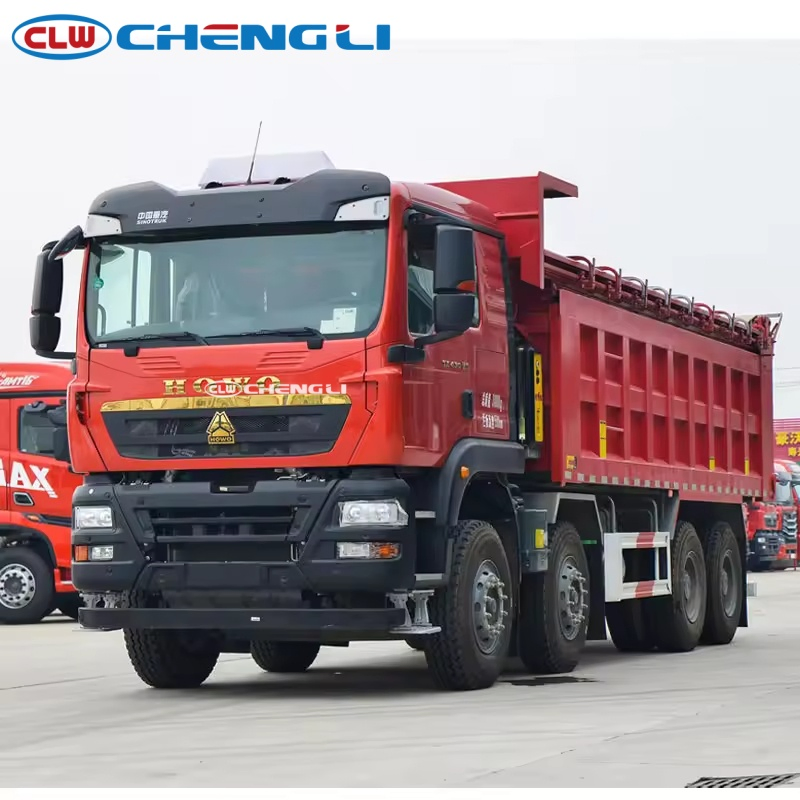
Compare the vehicle, not just the HOWO name
Browse the relevant vehicle category
HOWO identifies a chassis family, not one fixed tipper specification. An 8×4 truck with a long body and a compact 4×2 truck serve different access, loading and unloading requirements. Begin with the material, daily quantity, loading equipment and disposal point. Then compare the actual vehicle, including its drive arrangement and body drawing. Chengli Group offers project customisation and OEM/ODM services, so the body and equipment can be discussed alongside the selected chassis rather than treated as an immutable package.
The table compares five available starting configurations. An empty technical cell does not mean that the truck lacks that feature; it means that this comparison does not assign an unambiguous numerical specification. The HOWO TX price is a reference range, not a FOB or CIF quotation. The other four configurations are priced on request. Compare a written offer for the selected build rather than treating a broad range as the price of every truck carrying the same badge.
| Vehicle | Drive | Mass specification | Body dimensions | USD reference price |
|---|---|---|---|---|
| Sinotruk HOWO TX 8×4 Dump Truck | 8×4 | — | Project body selection | USD 25,800–41,200 |
| HOWO 6×4 10-Wheel Heavy-Payload Dump Truck | 6×4 | — | — | On request |
| HOWO 8×4 12-Wheel Dump Truck Configuration | 8×4 | — | — | On request |
| Sinotruk HOWO 8×4 Dump Truck, 39,500 kg GVW | 8×4 | 39,500 kg GVW | — | On request |
| Sinotruk 4×2 Mini Dump Truck, 4,495 kg GVW Configuration | 4×2 | 4,495 kg GVW | 3,600 × 2,100 × 600 mm | On request |
Separate body volume, payload and gross vehicle weight
Cubic metres describe volume; kilograms and tonnes describe mass. A large box may suit bulky material, but it is not a permission to carry the same numerical quantity in tonnes. Gross vehicle weight includes the complete loaded vehicle. Curb weight describes the unladen vehicle under the applicable specification, while payload describes its cargo allowance. These terms should appear separately in a purchase comparison. A 4,495 kg gross-vehicle specification is therefore not a promise that the compact truck carries 4,495 kg of material.
Prepare the comparison using the material as it will actually be loaded. Wet soil, dry spoil, gravel and large rock impose different requirements on the body and its usable load. Ask for the agreed payload, completed mass and axle distribution together. Where the catalogue comparison does not provide a clear cargo figure, keep that field out of the shortlist calculation until the offered configuration supplies it. Do not calculate a commercial payload from the headline body name, wheel count or chassis badge.
The compact Sinotruk body measures 3,600 × 2,100 × 600 mm. Those dimensions help discuss access and loading, but do not replace an interior-volume drawing or a rated payload. The larger HOWO comparisons also have different box dimensions in their technical records. Agree the particular body drawing, rather than transferring a dimension from another model. Side height, tailgate arrangement and the space available beneath the loading machine should be reviewed as one package with the material and chassis.
Match the drive layout to the route and unloading area
The 4×2 configuration is a candidate where access space and smaller deliveries matter. A 6×4 layout offers a different starting point for repeated site haulage, while 8×4 vehicles add another axle arrangement to the fleet comparison. These notations describe axle and drive arrangements; they do not guarantee manoeuvrability, traction, payload or permission to use a particular road. Review wheelbase, steering, tyres and the actual route separately. A longer truck can become impractical even when its body appears attractive on paper.
Unloading deserves its own site survey. Describe whether the vehicle will tip onto a stockpile, feed a hopper or work beside other equipment. Record the available approach, overhead obstructions and ground conditions. The body, tipping mechanism and tailgate must be compatible with that operation. A general comparison of rear or alternative discharge arrangements is not an operating instruction: drivers must use the delivered vehicle's instructions, and an unsuitable unloading surface should not be solved by choosing a bigger cylinder.
Build a like-for-like price and quotation brief
A useful request includes material, intended cargo mass, route length and surface, loading machine, preferred drive arrangement, steering side, destination and quantity. Add the body dimensions or drawing, wear protection, tailgate and tipping arrangement required. If the fleet already operates HOWO or Sinotruk equipment, identify the exact chassis and parts preference. This helps distinguish a practical compatibility request from an assumption that every truck in the same brand family uses interchangeable components.
Compare commercial scope as carefully as configuration. Chassis, body construction, hydraulic equipment and selected options can change the reference price. Ask each offer to state what is included, the delivery basis and the configuration revision. Do not compare a bare chassis with a completed tipper, or a body-only price with a complete vehicle. Where a model is marked On request, obtain its own offer; substituting the HOWO TX range would create an unsupported price for a different truck.
Use the dump-truck category to shortlist configurations, then keep one comparison sheet covering the offered technical and commercial package. The HOWO TX is a useful starting point for an 8×4 enquiry, but it should not determine every fleet purchase by default. A compact truck, a 6×4 and an 8×4 can all have a role within the same project when access and delivery cycles differ. Choose the fleet around the work, and agree each complete-vehicle specification before ordering.