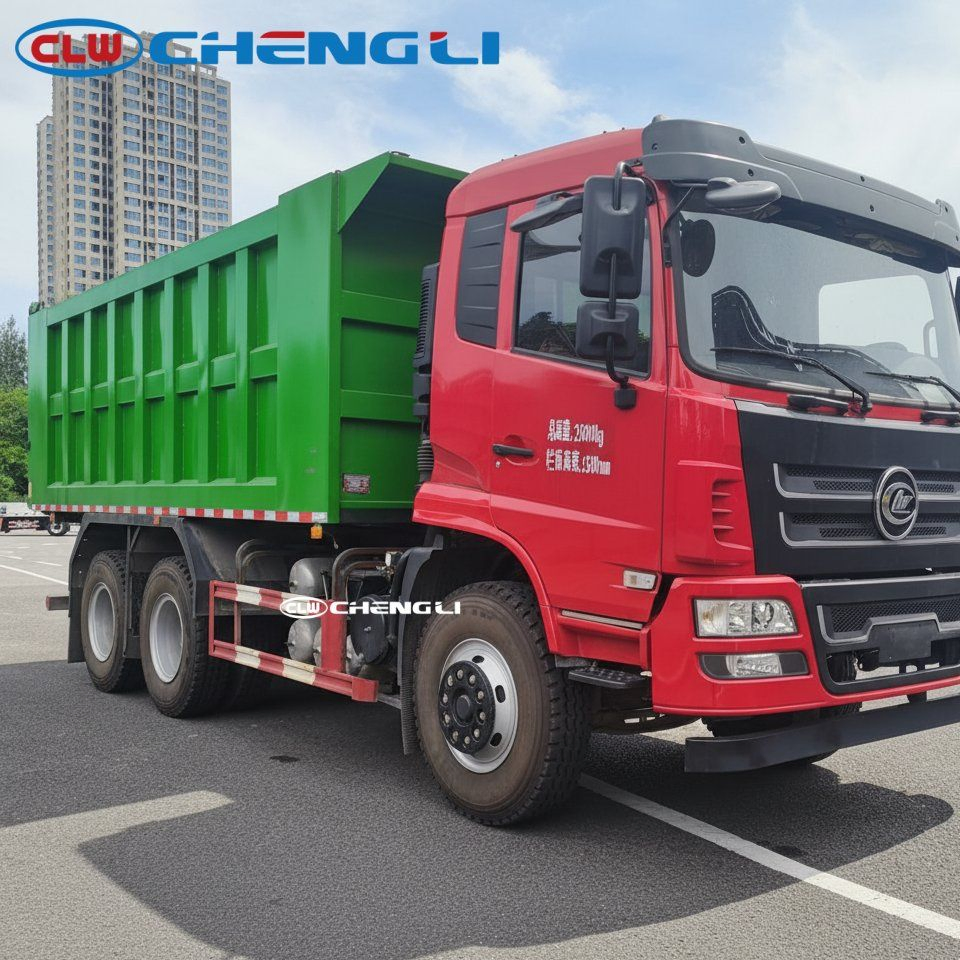
An 18 m³ body filled with material at 1.6 t/m³ contains 28.8 t of cargo. With a hypothetical 18 t cargo budget, the same material would be limited to 11.25 m³ before axle and loading checks. Use body dimensions to compare space, and material density plus the finished vehicle limits to decide how much of it can be used.
This guide concerns the load space on dump trucks and tipper trucks. For axle-layout selection, use the separate 6×4 versus 8×4 tipper guide. The two decisions interact, but choosing an axle arrangement is not a substitute for sizing the body around the material.
1. Keep volume, payload and vehicle mass separate
Body volume measures space, usually in cubic metres. Payload measures cargo mass, normally in kilograms or tonnes. Gross vehicle weight is the complete loaded vehicle; unladen or curb mass describes the truck without cargo under its stated weighing conditions. These terms belong in separate columns of a specification.
A stated body dimension also needs context. Establish whether the drawing uses internal loading dimensions or outside dimensions, how the front and tailgate are shaped, and whether the volume is struck or heaped. A rectangular calculation from length, width and height is a geometric comparison, not a certified usable-volume measurement.
Body plate, liners, covers and lifting equipment contribute to the truck's own mass. Changing the body can therefore affect the cargo allowance even when the chassis stays the same. Ask the proposal to show the completed vehicle mass and the operating load arrangement rather than referring only to the chassis badge.
2. Compare real body dimensions before selecting a size
These configurations illustrate different loading envelopes. Dimensions are retained as specified for the individual product. Calculations identify their mathematical basis; they are not a promise that every cubic metre can be filled with every material.
| Configuration | Body dimensions | Body-size interpretation |
|---|---|---|
| CL3255BDFA6-1 6×4 | 5,200 × 2,400 × 1,500 mm | Rectangular geometric calculation: 18.72 m³ |
| CLW 6×4 WP10.340E22 | 5,600 × 2,300 × 1,500 mm | Rectangular geometric calculation: 19.32 m³ |
| Foton GTL 8×4 | 6,500/6,700 × 2,300 × 1,500 mm | Alternative body lengths; compare the selected drawing |
The first rectangular calculation is 5.2 × 2.4 × 1.5 = 18.72 m³. The second is 5.6 × 2.3 × 1.5 = 19.32 m³. The difference is space, not extra tonnes of payload. Rounded corners, body taper, liners and the permitted fill profile can change the usable amount. Specify the final loading envelope on the agreed body drawing.
The Foton GTL entry gives alternative lengths, 6,500 or 6,700 mm. Treat these as separate body choices rather than combining them into a single exact volume. Select the body length that fits the intended chassis and loading arrangement. Also compare the loading machine's reach and the space available at the discharge point.
3. Compare the material before treating a full box as a load
Loose topsoil, dry sand and wet aggregate can put very different masses into the same space. Condition-specific loose-material estimating references are 0.95 t/m³ for topsoil, 1.42 t/m³ for dry sand, 1.84 t/m³ for wet sand and 2.02 t/m³ for wet sand-and-gravel. These are starting comparisons, not universal densities or acceptance limits. Loose material has been excavated or handled; do not substitute a bank-state or compacted-material density. Caterpillar Performance Handbook, June 2022, section 27-6.
For a separate hypothetical truck, assume 18 m³ of usable body space and an 18 t cargo mass budget. Neither is the rating of a linked vehicle. Multiplying volume by the reference density shows what filling that space would mean; dividing 18 t by density gives a preliminary mass-based volume ceiling.
| Loose material condition | Estimating density | Mass if 18 m³ is filled | Volume within both example limits | First limiting factor in this calculation |
|---|---|---|---|---|
| Topsoil | 0.95 t/m³ | 17.10 t | 18.00 m³ | Body space |
| Dry sand | 1.42 t/m³ | 25.56 t | 12.68 m³ | Cargo mass budget |
| Wet sand | 1.84 t/m³ | 33.12 t | 9.78 m³ | Cargo mass budget |
| Wet sand-and-gravel | 2.02 t/m³ | 36.36 t | 8.91 m³ | Cargo mass budget |
For wet sand, 18 t ÷ 1.84 t/m³ ≈ 9.78 m³. The extra box space cannot be used simply because the sidewalls are higher. At the topsoil reference, the full 18 m³ weighs 17.1 t, so space is reached first. The displayed volume ceilings are rounded; axle distribution and the actual vehicle and route can impose a lower limit. They are planning comparisons, not loading instructions.
For the same hypothetical 18 t cargo budget, the 1.42 and 1.84 t/m³ sand references give about 12.68 and 9.78 m³ respectively. This is why a dry-material loading mark should not automatically be used after the material changes. Moisture, grading, compaction and mixed loads need checking for the material actually loaded.
To replace the estimating value, obtain the loaded material's mass and the corresponding measured loose volume under the same conditions. For example, a clearly hypothetical 8.0 t sample occupying 5.0 m³ gives 8.0 ÷ 5.0 = 1.6 t/m³. Record the material, moisture condition, weighing and volume method, and repeat when the material changes. A nominal excavator-bucket size without its actual fill is not that volume measurement.
For planning, cargo mass in tonnes equals usable volume in cubic metres multiplied by bulk density in tonnes per cubic metre. Reverse the calculation for a preliminary volume ceiling: available cargo mass divided by measured bulk density. Then check axle distribution, fill profile and the applicable route limits. Never derive tank or body capacity from a vehicle's gross weight alone.
4. Specify the body for loading and discharge
Describe the material's particle size, moisture and tendency to stick, together with the loading method. Request the body shape, floor and sidewall specification, wear protection, tailgate and cover arrangement that suit that duty. An enlarged or higher-sided body may not be the best answer if it impedes loading or discharge.
Record overhead clearance and the area available for tipping. Follow the selected truck's operating instructions and the site's unloading procedure; no body-volume calculation establishes a safe tipping position. Include the intended unloading arrangement when choosing the body and hydraulic system.
Chengli offers project customisation and OEM/ODM. Send the material, measured density, target cargo mass, route and body drawing requirements together. Ask for a proposal showing body dimensions, completed mass and load distribution. Use the tipper truck price guide to compare the commercial scope after the working specification is clear.
A practical enquiry should state the normal load, the heaviest expected load, the daily work cycle and the loading machine used. Add chassis preference, steering side, destination and quantity. Request a body-sizing review rather than ordering solely by an attractive cubic-metre figure.
Tipper Bodies to Compare
- CL3255BDFA6-1 6×4 Dump Truck — Compare the 5,200 × 2,400 × 1,500 mm body and its 18.72 m³ rectangular calculation with the material-loading brief.
- CLW 6×4 WP10.340E22 Dump Truck — Compare the 5,600 × 2,300 × 1,500 mm body and its 19.32 m³ rectangular calculation to see how the loading envelope changes.
- Foton GTL 8×4 Dump Truck — Compare the 6,500 and 6,700 mm body-length alternatives when loading reach and unloading space influence the choice.